
Our Daily Bread

It’s my birthday today, which I’m going to use as an excuse for not posting something new. Here’s an older piece (like me!) for anyone who might not have read it already. I remember how fun it was to write this—it was one of those times where you’re just sitting around, not really thinking of anything in particular, and suddenly something sparks; a spurt of mental energy. Words and sentences begin to form, with no help from you, into a story. Your brain is entertaining itself! “Quick, quick, my quill!” you shout to your minions, and begin writing feverishly, trying to get the words down before they go back unto the dark recesses. It all feels a bit manic—just on the edge of crazy—and you’re thinking where the hell is this coming from? But you don’t really care because it’s fun.
This doesn’t happen to me often, but when it does, it’s just the best feeling. The great philosopher P.G. Wodehouse describes it well:
“Writing my stories I enjoy. It is the thinking them out that is apt to blot the sunshine from my life. You can’t think out plots like mine without getting a suspicion from time to time that something has gone seriously wrong with the brain’s two hemispheres and the broad band of transversely running fibers known as the corpus callosum. (…) The odd thing is that just as I am feeling that I must get a proproser and seconder and have myself put up for the loony bin, something always clicks and after that all is joy and jollity.”
Our Daily Bread
I moved back to my home town when I was twenty-six. I had been bumming around Europe for a while, free and broke, and now I was back and broke and it was time to get a job.
I got a job at a bakery—a really good bakery that sold really good breads and cookies and also had good coffee and sandwiches. The bakery was owned by a woman who was going through a divorce. She was short and sharp and energetic and friendly and scary in the way that short women who own places kind of have to be. She was good. She was into espresso and had recently installed a swanky machine. She put some time into teaching me how to use it and sent me home with books on the art of espresso making and I read them and eventually learned to pull a decent shot. I was into it because I loved coffee and had just come back from the land of café con leche and ristretto, but I was also always a little afraid of her, and of the machine, and of the discerning male customers who liked to come in and throw their weight around—espresso-expertise wise—for the benefit of me, the fumbling, pseudo-barista.
After a few months of working there, a french guy, the kind from France, started coming in and hanging around. He was not especially attractive but he was tall and young and had the accent. He smiled a lot and talked a lot and my boss started talking to him and laughing too much while she did and before long she decided we needed a new manager and hired him to be it. He had never been a manager before but like I said he was french and if you saw her around him you’d understand that that alone qualified him for …the position. For me it meant I had to spend a lot of time around this phony dude with the too-wide smile who didn’t know how a bakery worked or how to manage anyone. He was pretty terrible at it—kept fussing and reprimanding all of us non-managers right in front of the customers, and we had to keep our heads down and take it or risk a report of “back-talking” to the owner. I liked working at the bakery, especially during closing—a time of day I had previously enjoyed because I could be alone and blast classical music while I cleaned up and ate leftover cookies. But now the french manager started hanging around at closing so I could “show him the ropes” and the first thing he did was make me change the radio station to top 40 hits because he had an abhorrence of classical music: “it is not happy music. Customers want happy music!” and when I pointed out that there were no customers because we were closed he reported me to the boss for “back talk.” It’s not like I was listening to Shostakovich—it was just Mozart or whatever but this dude knew I liked it and that was enough. He went on being the manager and driving everyone crazy until the owner got tired of—I can’t bring myself to write the words, but we’ve all been middle-aged women fresh from a divorce at some point, in some sense, even if we haven’t—so I think we can all understand what she was doing and why. Eventually she got tired of doing it, and then he was out.
I liked working at the bakery, partly because of all the great bread I got to eat but also because sometimes at night after he got done with rehearsal at the playhouse across the street a handsome actor named Pablo would come in. Pablo was good-looking and seemed to think I was too which was gratifying because he was the same Pablo who had repeatedly dissed or ignored me all through the 2nd and 3rd grades—when he had also been extremely cute—and I had always wished he would notice me but he didn’t and then he moved to a different school. I had been frustrated at the time that he couldn’t see past the freckles and red hair and braces, but now, with the help of mascara and a sleek ponytail, I had my revenge. It wasn’t much of a revenge actually, because I had a boyfriend, and this Pablo—just like that other, famous guy also named Pablo—was kind of an asshole. But asshole or not, he was so good looking I could barely talk to him …all I could do was say “that’ll be five sixty-nine” as I rang him up for 2 cookies and a cortado, and try not to blush. Usually I put more than 2 cookies in his bag but that’s as far as our indiscretion was carried.
There was another guy who came in every morning, and I always gave him several more cookies than he had ordered, too. I did this rather judiciously because he was a cop. I was afraid of cops but also somehow sensible enough to realize that they were human beings just like me—some with a fondness for Black and Whites. This cop didn’t seem troubled by the fact that he was getting more cookies than he had paid for, and I justified my generosity by the fact that every night we gave away bags and bags of unsold cookies to a soup kitchen. So at worst I was stealing from the poor to give to the …cops. Well, maybe that wasn’t so great but it had recently come to my attention that I was on the Wrong Side of the Law, and having an in with the PD wasn’t the worst thing I could do. One day a few weeks before, my dad, as he was reading the paper, had said “Hey Anna, look at this: there’s a warrant out for your arrest!” and I had looked and there was. My dad seemed amused by it all and proceeded to cut the 2 lines about me out of the paper and tape them to the ‘fridge. Apparently he didn’t think the long arm of the law would reach to the kitchen. It was kind of impressive, being wanted, but I was a little worried because I didn’t know what it was for. What had I done? It wasn’t really that there was a warrant—that part almost made sense, because my whole existence felt mildly incriminating—I had always thought of myself as kind of inherently guilty, just in general, just for being me, and it made sense that I’d finally be caught and put away. But this was specific. It turned out to be because of an unpaid parking ticket: an ex-boyfriend had parked my car in a public lot but didn’t have the dollar to give the kiosk attendant as he drove out. The city responded to this by sending bills for a hundred years, each one accumulating a fresh fine, and I always said “you have to deal with this, please deal with this, just pay the ticket please,” but he didn’t and I didn’t and then I left the boyfriend and the country and now, years later, I found I had been living as a criminal on the run. So I started putting extra Black and Whites and sometimes a few Rugelachs in the cop’s cookie bag and we became friendly and finally one day I explained that I was wanted for arrest and asked him what I should do about it and he said oh don’t worry about that I’ll fix it and he did. Which made things a bit difficult in the sense that I loathed cops en masse, they were the enemy, etc., but here was this cop who loved cookies and had saved me from a life on the lam and what was I supposed to do with that? He and his kindly-cop ilk didn’t respect that I worked hard to nurture my contempt, and now they were upending my efforts. The moral of this story is either 1: The Fuzz can Always be Bought, or 2: Stereotyping is easy and dangerous and the antipathies we allow ourselves toward “the other” are too often undeserved …unless of course we’re talking about people named Pablo.
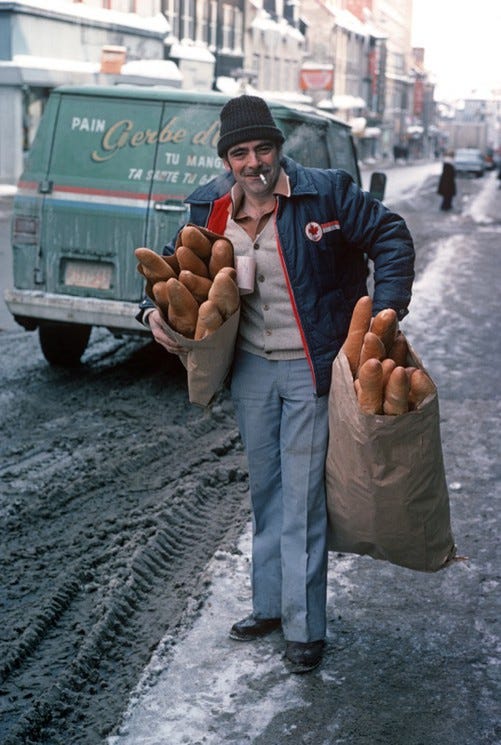
A good story and a great lesson … or the other way around … I’m not entirely sure … anyway, Happy Birthday!
Second time around is still delicious, like an extra cookie in my bag.