
The Humanity
L’Humanité

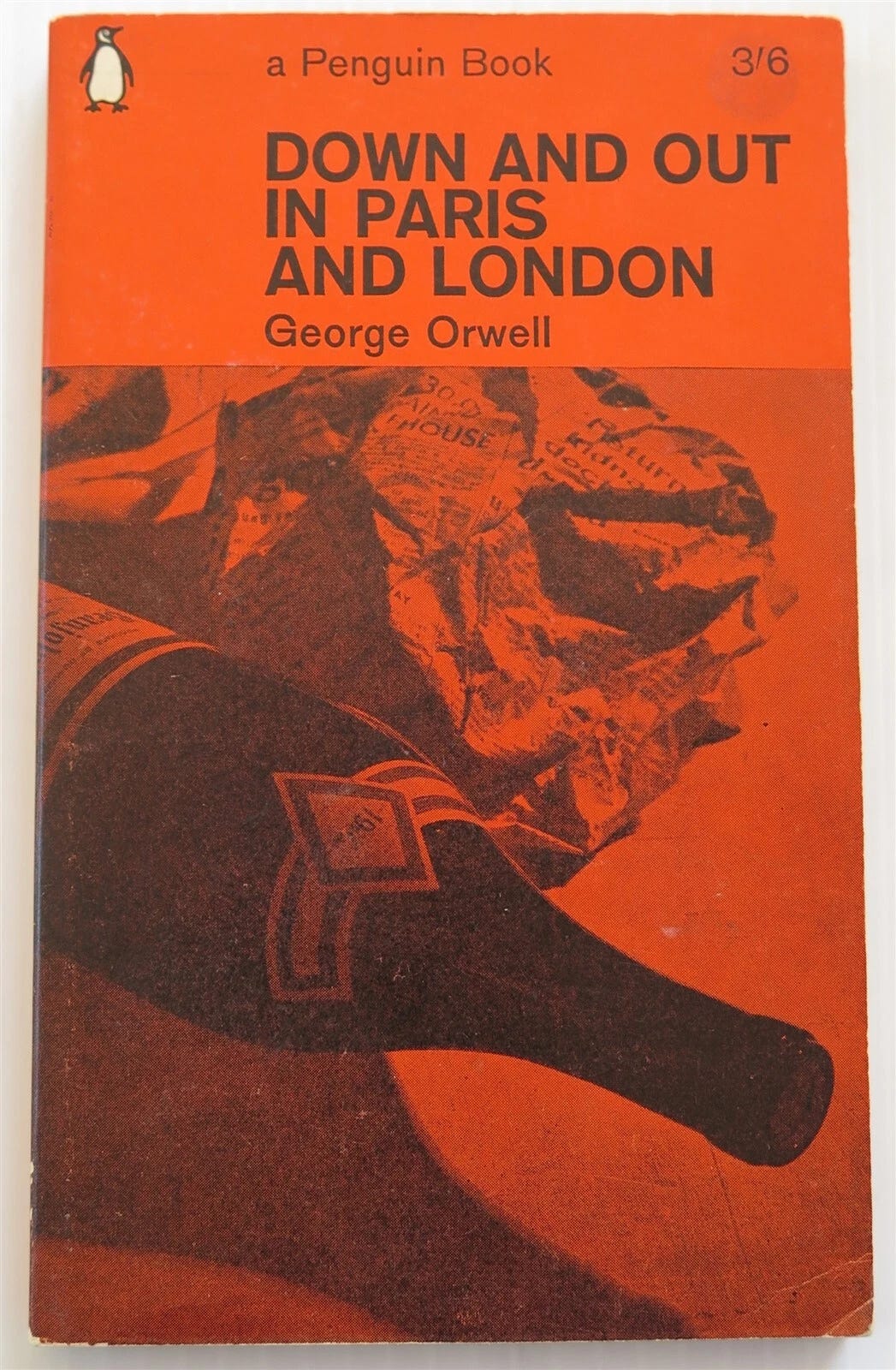
One of my favorite books is Down and Out in Paris and London by George Orwell. It’s about the time he went tramping through France and England, finding work where he could but mostly broke and hungry. He came from a middle-class background and didn’t have to do this—it was largely an experiment—with predictable conclusions. As well as suffering physical discomfort, he experienced, and wrote about, the dehumanizing disdain and rejection that he received from the haves, versus warmth and generosity from the have-nots.
The book has been, for better or worse, influential to me, and I have, at different times, set out to see just how little I myself needed to to get by, and how I might be treated, and what the world was really like. What I discovered, over and over again, was that there was a ratio of about twenty shitty people to one good one out there, but that that one was generous-hearted enough to make up for all the rest.
I also learned that living out of a cheap frame pack, with aching shoulders and blistered heels, bathing almost never, while sleeping under bushes or even highway meridians when the rides ran dry, with no meals or toilets when you needed ‘em, or—at an extremely low point—being pregnant with pneumonia while sleeping in a rain-soaked tent …was overrated.
I’m a long way from those days, and have grown pretty soft. These days I get bent out of shape if there’s, say, no milk for my coffee, or hot water for my shower, but mostly the lessons I learned then, about people, have lasted. I still love reading Down and Out in Paris and London—ideally from under a warm blanket while eating something rich and delicious. I love and almost revel in the way that Orwell describes his discomfort and disappointments, taking you right down with him. It’s fascinating and funny and alive. There are descriptions of hunger, of injuries and illness, of being too wet, too cold, too tired—with no relief in sight. Life sucks without money or a home. But then! Somebody finds a franc in the mud! Hot tea, a room for the night! A mattress, even! Bedbugs be damned, this is more like it.
Here’s a wonderful and wonderfully uncomfortable scene—Saturday night in the bar of the hotel where George has managed to rent a room. It starts out full of wine and bonhomie—and then, as the night wines on—goes straight downhill, gets run over by a passing lorry, and splatters all over the pavement.
“We had some jolly evenings, on Saturdays, in the little bistro at the foot of the Hôtel des Trois Moineaux.
The brick-floored room, fifteen feet square, was packed with twenty people, and the air dim with smoke. The noise was deafening, for everyone was either talking at the top of his voice or singing. Sometimes it was just a confused din of voices; sometimes everyone would burst out together in the same song—the ‘Marseillaise’, or the ‘Internationale’, or ‘Madelon’, or ‘Les Fraises et les Fram-boises’. Azaya, a great clumping peasant girl who worked fourteen hours a day in a glass factory, sang a song about, ‘Il a perdu ses pantalons, tout en dansant le Charleston.’ Her friend Marinette, a thin, dark Corsican girl of obstinate virtue, tied her knees together and danced the danse du ventre. The old Rougiers wandered in and out, cadging drinks and trying to tell a long, involved story about someone who had once cheated them over a bedstead. R., cadaverous and silent, sat in his corner quietly boozing. Charlie, drunk, half danced, half staggered to and fro with a glass of sham absinthe balanced in one fat hand, pinching the women’s breasts and declaiming poetry. People played darts and diced for drinks. Manuel, a Spaniard, dragged the girls to the bar and shook the dice-box against their bellies, for luck. Madame F. stood at the bar rapidly pouring chopines of wine through the pewter funnel, with a wet dishcloth always handy, because every man in the room tried to make love to her. Two children, bastards of big Louis the bricklayer, sat in a corner sharing a glass of sirop. Everyone was very happy, overwhelmingly certain that the world was a good place and we a notable set of people.
For an hour the noise scarcely slackened. Then about midnight there was a piercing shout of ‘Citoyens!’ and the sound of a chair falling over. A blond, red-faced workman had risen to his feet and was banging a bottle on the table. Everyone stopped singing; the word went round, ‘Sh! Furex is starting!’ Furex was a strange creature, a Limousin stonemason who worked steadily all the week and drank himself into a kind of paroxysm on Saturdays. He had lost his memory and could not remember anything before the war, and he would have gone to pieces through drink if Madame F. had not taken care of him. On Saturday evenings at about five o’clock she would say to someone, ‘Catch Furex before he spends his wages,’ and when he had been caught she would take away his money, leaving him enough for one good drink. One week he escaped, and, rolling blind drunk in the Place Monge, was run over by a car and badly hurt.
The queer thing about Furex was that, though he was a Communist when sober, he turned violently patriotic when drunk. He started the evening with good Communist principles, but after four or five litres he was a rampant Chauvinist, denouncing spies, challenging all foreigners to fight, and, if he was not prevented, throwing bottles. It was at this stage that he made his speech—for he made a patriotic speech every Saturday night. The speech was always the same, word for word. It ran:
‘Citizens of the Republic, are there any Frenchmen here? If there are any Frenchmen here, I rise to remind them—to remind them in effect, of the glorious days of the war. When one looks back upon that time of comradeship and heroism—one looks back, in effect, upon that time of comradeship and heroism. When one remembers the heroes who are dead—one remembers, in effect, the heroes who are dead. Citizens of the Republic, I was wounded at Verdun—’
Here he partially undressed and showed the wound he had received at Verdun. There were shouts of applause. We thought nothing in the world could be funnier than this speech of Furex’s. He was a well-known spectacle in the quarter; people used to come in from other bistros to watch him when his fit started.
The word was passed round to bait Furex. With a wink to the others someone called for silence, and asked him to sing the ‘Marseillaise’. He sang it well, in a fine bass voice, with patriotic gurgling noises deep down in his chest when he came to ‘Aux arrmes, citoyens! Forrmez vos bataillons!’ Veritable tears rolled down his cheeks; he was too drunk to see that everyone was laughing at him. Then, before he had finished, two strong workmen seized him by either arm and held him down, while Azaya shouted, ‘Vive l’Allemagne!’ just out of his reach. Furex’s face went purple at such infamy. Everyone in the bistro began shouting together, ‘Vive l’Allemagne! à bas la France!’ while Furex struggled to get at them. But suddenly he spoiled the fun. His face turned pale and doleful, his limbs went limp, and before anyone could stop him he was sick on the table. Then Madame F. hoisted him like a sack and carried him up to bed. In the morning he reappeared quiet and civil, and bought a copy of L’Humanité.
The table was wiped with a cloth, Madame F. brought more litre bottles and loaves of bread, and we settled down to serious drinking. There were more songs. An itinerant singer came in with his banjo and performed for five-sou pieces. An Arab and a girl from the bistro down the street did a dance, the man wielding a painted wooden phallus the size of a rolling-pin. There were gaps in the noise now. People had begun to talk about their love-affairs, and the war, and the barbel fishing in the Seine, and the best way to faire la révolution, and to tell stories. Charlie, grown sober again, captured the conversation and talked about his soul for five minutes. The doors and windows were opened to cool the room. The street was emptying, and in the distance one could hear the lonely milk train thundering down the Boulevard St Michel. The air blew cold on our foreheads, and the coarse African wine still tasted good: we were still happy, but meditatively, with the shouting and hilarious mood finished.
By one o’clock we were not happy any longer. We felt the joy of the evening wearing thin, and called hastily for more bottles, but Madame F. was watering the wine now, and it did not taste the same. Men grew quarrelsome. The girls were violently kissed and hands thrust into their bosoms and they made off lest worse should happen. Big Louis, the bricklayer, was drunk, and crawled about the floor barking and pretending to be a dog. The others grew tired of him and kicked at him as he went past. People seized each other by the arm and began long rambling confessions, and were angry when these were not listened to. The crowd thinned. Manuel and another man, both gamblers, went across to the Arab bistro, where card-playing went on till daylight. Charlie suddenly borrowed thirty francs from Madame F. and disappeared, probably to a brothel. Men began to empty their glasses, call briefly, ‘’Sieurs, dames!’ and go off to bed.
By half past one the last drop of pleasure had evaporated, leaving nothing but headaches. We perceived that we were not splendid inhabitants of a splendid world, but a crew of underpaid workmen grown squalidly and dismally drunk. We went on swallowing the wine, but it was only from habit, and the stuff seemed suddenly nauseating. One’s head had swollen up like a balloon, the floor rocked, one’s tongue and lips were stained purple. At last it was no use keeping it up any longer. Several men went out into the yard behind the bistro and were sick. We crawled up to bed, tumbled down half dressed, and stayed there ten hours.
Most of my Saturday nights went in this way. On the whole, the two hours when one was perfectly and wildly happy seemed worth the subsequent headache. For many men in the quarter, unmarried and with no future to think of, the weekly drinking-bout was the one thing that made life worth living.”
…may your shower always run hot.
Epic description of a Saturday night by Orwell! Just reading it gives me a hangover.
Orwell’s poverty is a boisterous break from Hemingway’s in A Moveable Feast, which I’m rereading. Hemingway is so ornery compared to Orwell.